


 0808 234-2046
 1 800 983 148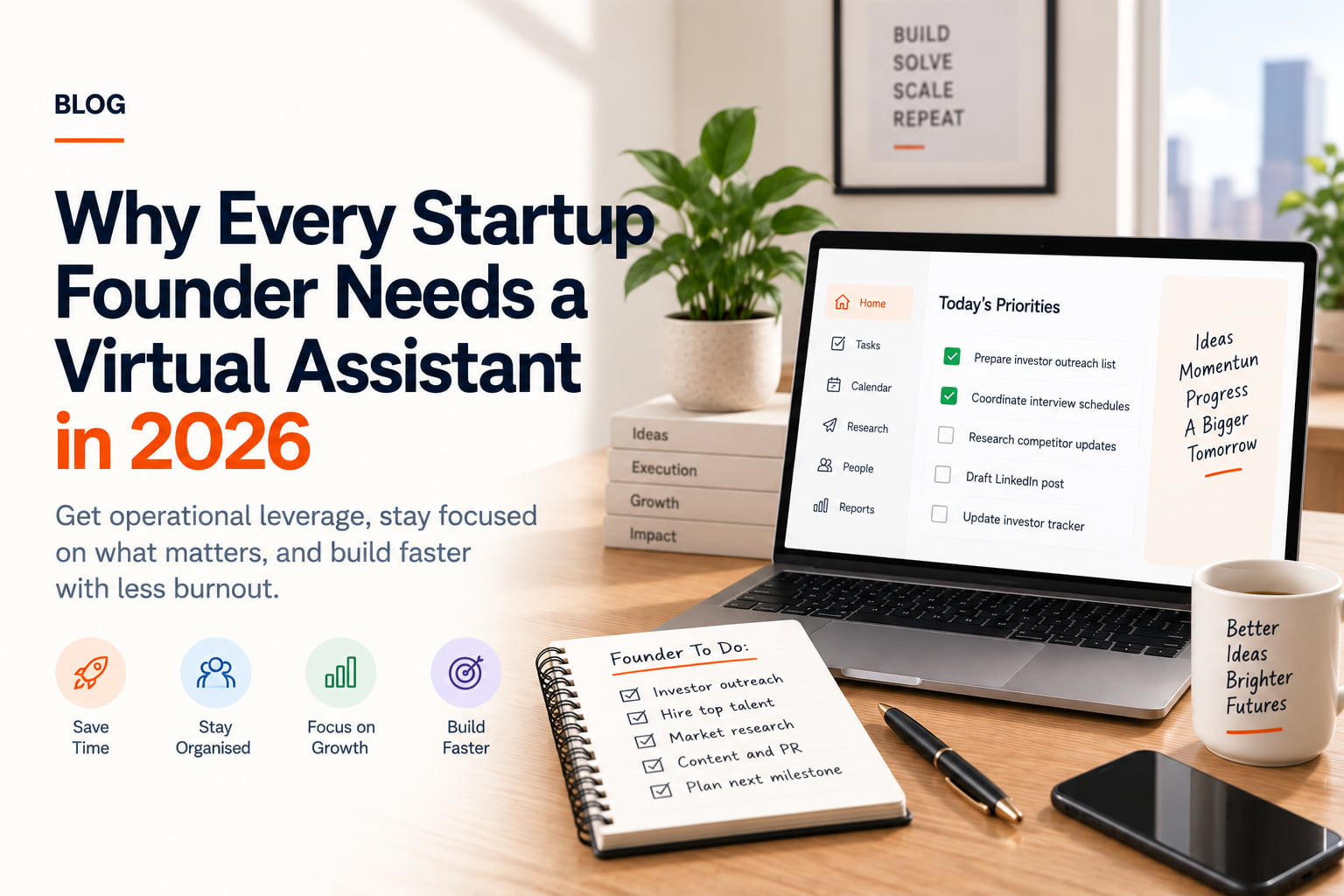
Why Every Startup Founder Needs a Virtual Assistant in 2026
Startup founders are some of the most time-stretched professionals on earth. You're simultaneously the CEO, the sales team, the product manager, the marketer, and often the customer support rep — all while trying to build something that scales.
A virtual assistant won't replace your co-founder or your first engineering hire. But it will take the operational weight off your shoulders at the exact stage when your time is most valuable and most scarce. Here's why — and how.
Quick Summary
- Founders waste 15–20 hours/week on operational tasks that don't require their expertise.
- A VA gives you senior-founder leverage at an early-stage price point.
- AskSunday's dedicated VA plans are built for fast-moving, high-demand founders
The Founder Time Problem
A study by Harvard Business Review found that CEOs spend only 6% of their time on strategy and long-term planning. The rest goes to meetings, communications, and operational management. For startup founders, that ratio is often even worse — because there's no team to absorb the operational layer.
Every hour you spend on admin, scheduling, research, or repetitive tasks is an hour not spent on product, fundraising, sales, or hiring — the activities that actually determine whether your startup succeeds.
What a VA Does for Startup Founders
Investor Relations Admin
Managing investor update emails, tracking LP communications, scheduling pitch meetings, and following up after introductions — your VA keeps your investor relationships warm and your outreach moving.
Fundraising Research
Building targeted investor lists, researching fund theses and portfolio companies, identifying warm introduction paths, and tracking outreach status in your CRM — your VA does the research leg work behind every fundraise.
Hiring and Recruitment Admin
Posting job descriptions, screening initial applications against criteria, coordinating interview schedules, and managing candidate communications — your VA handles recruitment ops so hiring doesn't consume your calendar.
Vendor and Tool Management
Evaluating SaaS tools, comparing pricing plans, managing subscriptions, coordinating with contractors, and handling vendor onboarding — your VA keeps your operational stack running efficiently.
Market and Competitor Research
Tracking competitor launches, monitoring industry news, compiling market intelligence reports, and flagging relevant developments — your VA is your eyes and ears on the market.
Board and Team Meeting Preparation
Pulling metrics, preparing slide data, formatting decks, sending pre-reads, and tracking action items post-meeting — your VA handles meeting ops so you walk in prepared every time.
Customer and Partner Outreach
Managing outbound sequences, following up on warm intros, scheduling discovery calls, and tracking pipeline status — your VA keeps your commercial conversations moving.
Content and Thought Leadership
Drafting LinkedIn posts, writing newsletters, preparing conference talk outlines, and managing PR media lists — your VA keeps you visible while you stay focused on building.
Startup Stage: When to Hire a VA
| Stage | Signal to Hire a VA | First Tasks to Delegate |
|---|---|---|
| Pre-Seed | Spending 10 hrs/week on non-product work | Scheduling, research, email triage |
| Seed | Fundraising consuming all strategic time | Investor research, recruitment admin, reporting |
| Series A | Team growing, ops complexity rising | Vendor management, comms, board prep |
| Series B+ | Founder still handling admin personally | Full operational delegation to VA team |
VA vs. First Full-Time Ops Hire: What's the Difference?
Many founders debate between hiring a VA or making their first full-time operations hire. The answer often depends on stage:
- Before product-market fit: A VA gives you operational coverage without fixed headcount costs. Preserve runway.
- After PMF with growing revenue: A VA still makes sense while you validate what your ops hire should actually do.
- Rule of thumb: If you can define the role clearly and it requires 40 hours/week of institutional knowledge — hire full time. Until then, a VA is almost always the better ROI.
Founder ROI Calculation
- If your time is worth $500/hour (based on funding round equity value)...
- ...and you spend 15 hours/week on admin that a VA can handle...
- ...that's $7,500/week in founder time consumed by non-strategic work.
- A dedicated VA plan costs a fraction of that. The math is decisive
How AskSunday Supports Startup Founders
- Dedicated VA who understands startup pace and priorities
- Expert team backup for specialized research, content, and investor communications
- Flexible month-to-month plans — no long-term contracts as your needs evolve
- Fast matching — your VA can start within 1–3 business days
- Free trial available — test before you commit
Final Thoughts
The best-funded, fastest-growing startups are the ones where founders spend their time on the things only they can do. A virtual assistant is the first line of operational leverage — and in 2026, it's one of the most cost-effective investments a founder can make.
Start your free trial with AskSunday. Your next breakthrough might be 10 hours of reclaimed founder time away.
Frequently Asked Questions
Is a VA right for a pre-revenue startup?
Yes — if you're spending meaningful time on non-strategic tasks. Even at pre-revenue stage, a VA paying for itself in founder time reclaimed at 10+ hours/week is excellent ROI against runway.
Can a VA help with investor outreach?
Yes. Your VA can build investor lists, research fund theses, manage outreach tracking, and coordinate intro requests. Strategic decisions and actual pitch conversations remain with you.
How do I keep a VA aligned with a fast-moving startup?
Weekly 15-minute priority check-ins and a shared task manager (Notion, Linear, or Asana) are usually sufficient. Your VA adapts to your priorities week by week.