


 0808 234-2046
 1 800 983 148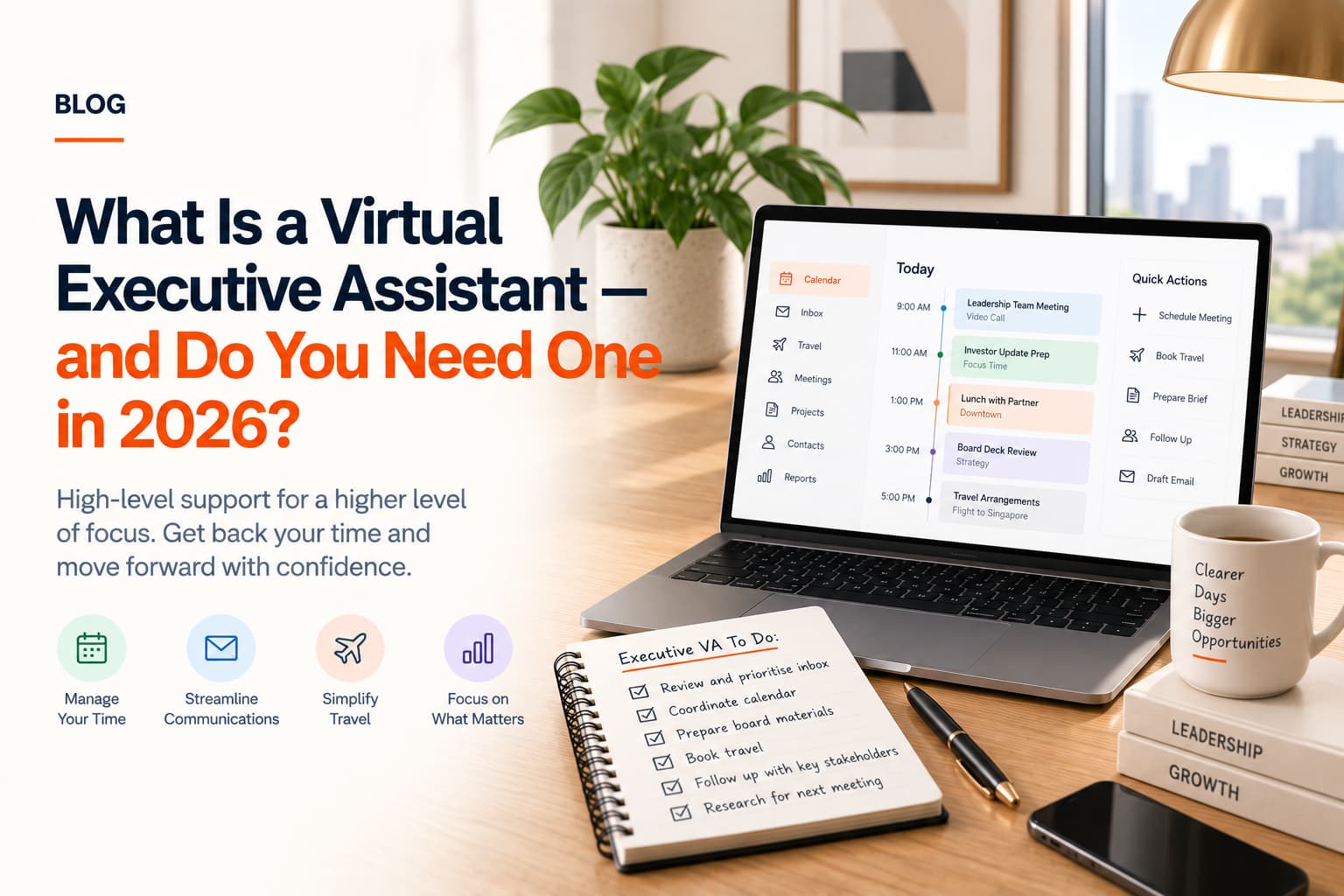
What Is a Virtual Executive Assistant — and Do You Need One in 2026?
For decades, a great executive assistant was one of the most coveted resources in business — a trusted professional who managed your calendar, filtered your communications, coordinated your travel, and kept your life running smoothly. The challenge was always cost: a skilled, full-time EA commands a salary of $60,000–$100,000+ per year.
Enter the virtual executive assistant. In 2026, a dedicated virtual EA delivers the same level of high-touch, proactive support — at a fraction of the cost, with no office space required. Here's everything you need to know.
Quick Summary
- A virtual executive assistant (VEA) provides senior-level support: complex scheduling, communications management, travel, board prep, and stakeholder coordination.
- VEAs are ideal for CEOs, partners, directors, and senior executives who need more than basic admin support.
- AskSunday's dedicated plans offer executive-level VA support with subject matter expert team backup.
Virtual EA vs. Standard VA: What's the Difference?
| Dimension | Standard VA | Virtual Executive Assistant |
|---|---|---|
| Task level | Routine admin, data entry, research | Complex coordination, high-stakes communications |
| Judgment required | Low to medium | High — acts on your behalf with authority |
| Stakeholder interaction | Internal or low-touch | Executives, board members, clients, investors |
| Calendar management | Basic scheduling | Complex multi-party negotiation, conflict management |
| Communication | Templated responses | Drafts sensitive or strategic correspondence |
| Proactiveness | Reactive to tasks | Anticipates needs and acts before being asked |
A virtual executive assistant is typically a more senior, experienced VA who has worked in corporate environments and understands the dynamics of executive-level support.
What a Virtual Executive Assistant Handles
1. Complex Calendar and Schedule Management
Your VEA manages a multi-layered calendar across time zones, priorities, and stakeholder needs. They negotiate meeting times with other executives' assistants, protect your deep work time, and ensure your week reflects your actual priorities — not everyone else's.
2. Executive Communications Management
Your VEA manages your inbox at a senior level — drafting responses to board members, investors, and key partners in your voice, flagging strategic communications, and handling routine correspondence independently.
3. Board and Investor Relations Coordination
Preparing board packs, circulating pre-reads, coordinating logistics for board meetings, tracking action items, and managing follow-up communications — your VEA runs the board operations cycle.
4. Strategic Research and Briefing Documents
Before every important meeting, your VEA prepares a briefing document: who you're meeting, their background, recent news, mutual connections, and suggested talking points. You walk into every meeting prepared.
5. High-Stakes Travel Management
Multi-city itineraries, international travel with visa requirements, last-minute changes, and VIP guest coordination — your VEA manages executive travel at the standard your status demands.
6. Stakeholder and Relationship Management
Tracking important relationships, flagging anniversaries and touchpoints, managing gift sending, and ensuring your network receives the attention that sustains long-term business relationships.
7. Personal and Household Coordination
At executive level, personal and professional life are deeply intertwined. Your VEA coordinates household staff, manages personal appointments, handles family logistics, and ensures your personal life runs smoothly alongside your professional one.
8. Confidential Project Management
M&A research, competitive intelligence, confidential HR matters, or strategic initiative tracking — your VEA handles sensitive projects with absolute discretion.
Who Needs a Virtual Executive Assistant?
- CEOs and founders of growing companies spending significant time on operational management
- Managing partners at law firms, consultancies, or investment firms
- Senior executives transitioning between companies who need rapid operational setup
- Board members managing multiple directorships
- High-net-worth individuals with complex personal and professional calendars
How a VEA Differs from a Chief of Staff
A Chief of Staff is a strategic role — they often own projects, manage teams, and represent you in high-stakes internal decisions. A virtual executive assistant is an operational role — they execute and coordinate, enabling you to be more effective without making strategic decisions on your behalf.
Many executives benefit from both: a VEA for operational support and a fractional Chief of Staff for strategic oversight. At AskSunday, our expert team backup can flex into both domains.
Executive Client Profile
- Typical AskSunday executive client: CEO of a 20–200 person company, managing 200+ emails per day, 15+ meetings per week, multiple board relationships, and regular international travel.
- Outcome after 90 days: inbox under control, calendar protected, board materials consistently on time, and 10–15 hours of strategic focus time reclaimed per week.
Why AskSunday for Executive-Level Support
- Senior dedicated VAs with experience in executive support environments
- Rigorous vetting, NDA signing, and confidentiality protocols as standard
- Expert team backup: your VEA can draw on specialist support for research, design, and communications
- Month-to-month plans — no lock-in, scale as your needs evolve
- Free trial — experience executive-level support before committing
Final Thoughts
The most effective executives in 2026 don't manage their own calendars, draft their own routine emails, or chase their own logistics. They have trusted support systems that handle the operational layer — so their attention stays on the decisions and relationships that drive the organisation forward.
A virtual executive assistant makes that level of support accessible without a full-time salary. Start your free trial with AskSunday and experience what it means to operate at your highest level.
Frequently Asked Questions
Can a virtual EA replace a full-time in-office EA?
For many executives, yes — particularly those who work remotely or travel frequently. The key is finding a VEA with the experience level and proactiveness your role demands. AskSunday matches you based on your specific requirements.
How do I maintain confidentiality with a virtual EA?
All AskSunday VAs sign NDAs as standard. For executive clients handling board-level or M&A-sensitive information, additional confidentiality agreements can be arranged.
What tools does a virtual EA typically use?
Google Workspace or Microsoft 365 for communications and calendar; Notion or Asana for project tracking; travel platforms for booking; Slack or Teams for real-time communication. Your VEA adapts to your existing stack.