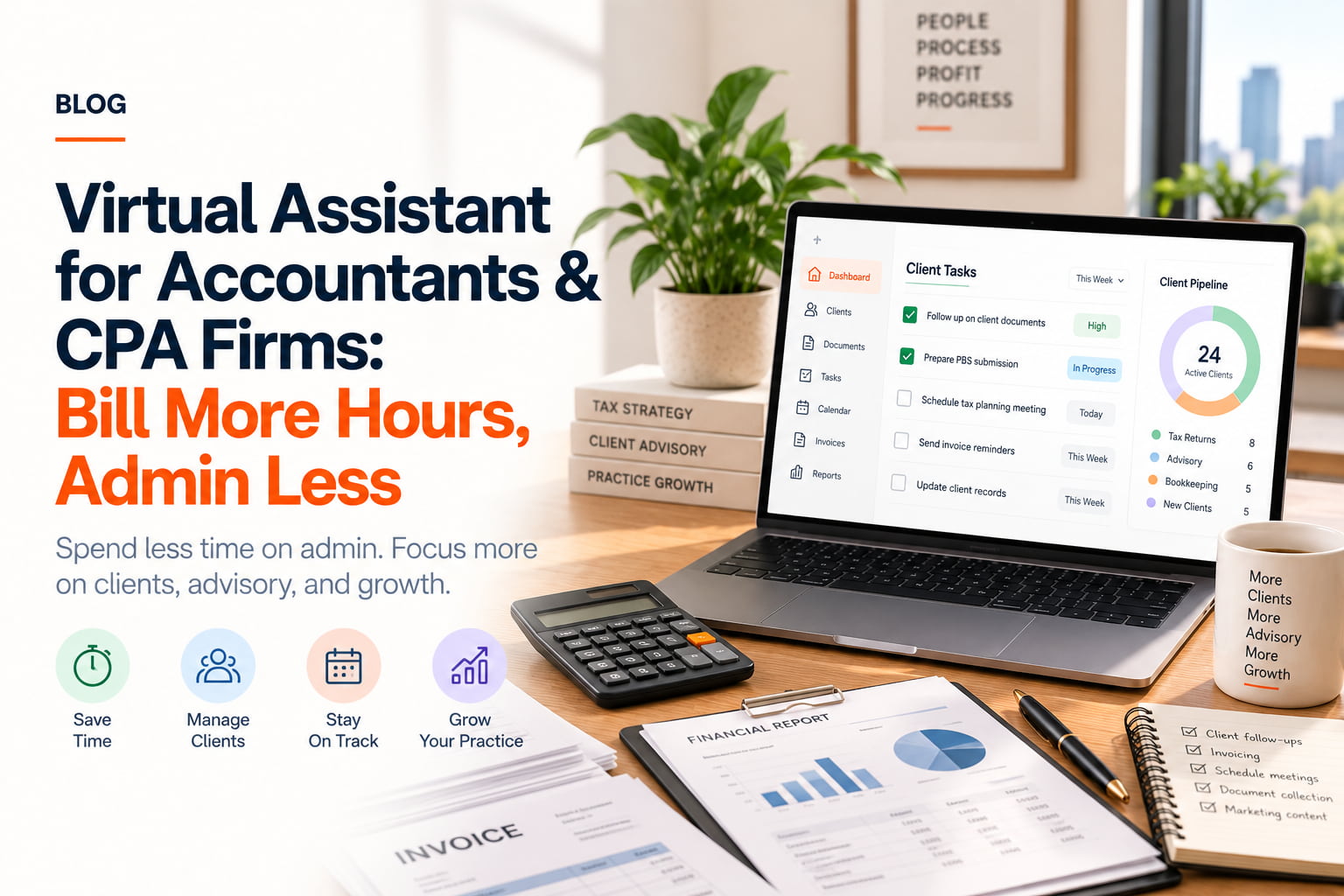
Accountants and CPA firms operate in a world of precision and deadlines — yet a significant portion of every practitioner's week is consumed by tasks that don't appear on any timesheet: chasing client documents, scheduling meetings, managing emails, coordinating with referral partners, and maintaining a marketing presence.
A virtual assistant can absorb the non-billable administrative layer of your practice, allowing you to redirect those hours toward client work, advisory services, and firm growth.
Quick Summary
- Accounting VA tasks include client document chasing, scheduling, CRM management, marketing, and practice admin.
- Recovering 10 billable hours per month at $250/hour = $2,500 in additional revenue.
- AskSunday's dedicated VAs support solo accountants, bookkeeping practices, and multi-partner CPA firms.
The Non-Billable Hour Problem
The average accounting professional spends 30–40% of their working week on non-billable activities. At $200–$400/hour billing rates, that's $3,000–$8,000 in recoverable revenue per practitioner per month — consumed by admin that doesn't require accounting qualifications.
A VA recaptures those hours without adding a qualified professional to your payroll.
What an Accounting Practice VA Can Handle
1. Client Document Chasing
The single most time-consuming non-billable activity in most accounting practices: following up with clients for missing bank statements, receipts, payroll records, and prior year returns. Your VA manages the full chase process, so your accountants aren't making awkward reminder calls.
2. Client Scheduling and Appointment Coordination
Booking tax planning meetings, year-end reviews, onboarding consultations, and advisory sessions — your VA manages your calendar and your clients' schedules simultaneously, sending confirmations and reminders.
3. Onboarding New Clients
Sending engagement letters for signing, collecting information questionnaires, setting up client records in your practice management system, and orienting new clients to your portal and workflows — your VA runs a seamless onboarding process.
4. Practice Management System Maintenance
Keeping client records current in your practice management software (Karbon, TaxDome, Canopy, or Xero Practice Manager), logging correspondence, updating deadlines, and tracking engagement status — your VA maintains your system accuracy.
5. Deadline and Compliance Calendar Management
Tracking filing deadlines, extension requests, estimated tax payment dates, and regulatory deadlines across your client roster — your VA maintains a compliance calendar that flags upcoming deadlines well in advance.
6. Marketing and Thought Leadership Content
Writing and scheduling your monthly tax tip newsletter, managing LinkedIn content, and drafting educational blog posts — your VA keeps your practice visible to existing clients and prospects without requiring your time.
7. Referral Partner Relationship Management
Scheduling regular touchpoints with referral partners (lawyers, financial advisors, business bankers), sending case study updates, and managing the referral tracking process — your VA keeps your referral relationships active.
8. Prospect Follow-Up and Pipeline Management
Following up with enquiries, scheduling discovery calls, tracking prospect status in your CRM, and sending follow-up materials — your VA converts more enquiries into clients through consistent follow-up.
9. Staff Meeting Coordination and Minutes
Scheduling internal team meetings, preparing agendas, taking meeting minutes, distributing action items, and tracking completion — your VA handles internal coordination efficiently.
10. Invoice Creation and Accounts Receivable
Generating client invoices based on your billing records, sending them on schedule, following up on outstanding payments, and preparing aged debtors reports — your VA keeps your practice cash flow healthy.
Billing Rate ROI Calculation
| Hours Recovered/Month | Billing Rate | Additional Monthly Revenue |
|---|---|---|
| 5 hours | $200/hr | $1,000/month |
| 10 hours | $200/hr | $2,000/month |
| 10 hours | $350/hr | $3,500/month |
| 20 hours | $300/hr | $6,000/month |
Practice Growth Impact
- Most accounting practices find their VA pays for itself within the first recovered billing cycle.
- Beyond revenue: practitioners report lower stress, fewer deadline near-misses, and improved client satisfaction.
- Document chasing alone — when done consistently by a VA — reduces late filing penalties and client friction significantly.
What Your Accounting VA Must Not Do
- Prepare or review tax returns or financial statements
- Provide tax advice or interpret regulations
- Access client financial systems or accounting files without explicit authorisation
- Make representations to regulatory bodies on behalf of the firm or clients
Tools Your Accounting Practice VA Should Know
| Tool | Function |
|---|---|
| Karbon / Canopy / TaxDome | Practice management, client portal, deadline tracking |
| Xero Practice Manager | Client records, job management, WIP tracking |
| DocuSign / Adobe Sign | Engagement letter and document e-signing |
| Calendly / Acuity | Client scheduling automation |
| Mailchimp / ActiveCampaign | Newsletter and email marketing |
| HubSpot / Salesforce | CRM and pipeline management |
Why AskSunday for Accountants and CPA Firms
- Dedicated VA who learns your practice workflows, client base, and compliance calendar
- Strict confidentiality — NDA signed as standard, data handling protocols established on Day 1
- Experience with accounting practice management platforms
- Flexible plans — scale up during tax season, adjust in quieter periods
- Free trial available
Final Thoughts
Every non-billable hour your accountants spend on admin is a cost to your practice. A virtual assistant transforms that cost into recovered revenue — often multiple times the cost of the VA plan itself — while simultaneously improving client experience and reducing staff stress.
Start your free trial with AskSunday and start billing the hours you're currently giving away.
Frequently Asked Questions
Can a VA access our client portal?
Yes, with limited permissions established during onboarding. Your VA can download and upload documents, track status, and manage communications within your portal without access to sensitive financial records.
Can a VA help during the busy tax season?
Yes — and this is when the impact is most felt. Your VA handles document chasing, scheduling, and client communications at peak volume, allowing your accountants to focus entirely on preparation and review.
Can a VA write content for our accounting firm without being an accountant?
Yes. With your topic direction and key points provided, your VA writes accessible, professional content about tax planning, financial management, and business advisory topics — targeting your ideal client audience.