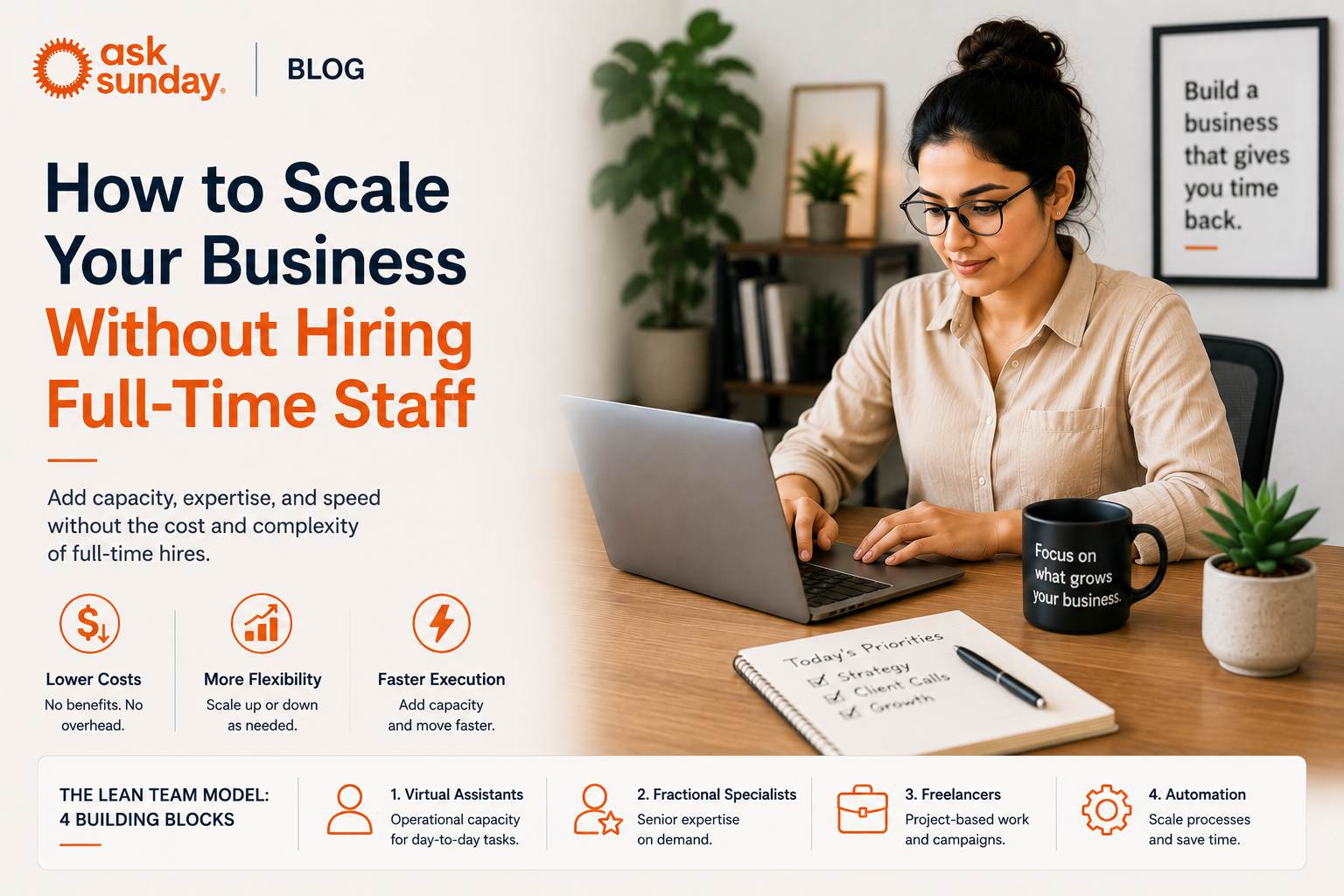
The traditional growth model says: more revenue means more hires. But for today's entrepreneurs and lean businesses, that equation has been rewritten. The fastest-growing companies of the last decade aren't the most staffed — they're the most leveraged.
In this guide, we break down the lean team playbook: how to add genuine operational capacity, specialized expertise, and consistent execution to your business — without the overhead, commitment, and management burden of full-time employees.
The Lean Team Principle
- Every additional full-time employee adds cost, management complexity, and legal liability.
- The goal isn't more people — it's more output per person, and more value per dollar spent.
- Virtual assistants, fractional specialists, and automation are the building blocks of the modern lean team.
Why Full-Time Hiring Isn't Always the Answer
When revenue grows, the instinct is to hire. But full-time employees come with a long tail of costs and complexity:
- Salary and benefits: typically 1.25–1.4x base salary in total employment cost
- Recruitment time and cost: 4–8 weeks of your time to hire, plus potential agency fees
- Onboarding investment: 60–90 days before a new hire is fully productive
- Management overhead: regular 1:1s, performance reviews, HR processes
- Fixed cost in variable revenue periods: employees cost the same whether revenue dips or grows
For many tasks — especially operational, administrative, or project-based work — there's a better way.
The Lean Team Model: 4 Building Blocks
1. Virtual Assistants for Operational Capacity
A dedicated VA handles the operational layer of your business: admin, email, scheduling, research, content, customer service, and more. This is the foundational building block of the lean team — it frees the core team to work on higher-value activities.
Cost vs. full-time equivalent: A dedicated VA typically costs 50–70% less than a full-time operations hire, with no benefits, office space, or management overhead.
2. Fractional Specialists for Expertise
A fractional CFO, fractional CMO, or fractional HR director gives you C-suite expertise at 20% of the cost of a full-time hire. These professionals work across multiple clients — giving you senior strategic input without the full-time salary.
When to use: When you need expertise but not full-time presence. Common fractional roles: finance, marketing strategy, people operations, legal, technical CTO.
3. Freelancers for Project-Based Work
Designers, developers, copywriters, and consultants hired on a project basis give you world-class output without ongoing commitment. Platforms like Upwork, Toptal, and 99designs connect you with vetted talent for defined scopes.
When to use: Website builds, brand refreshes, specific campaigns, technical projects with a clear start and end.
4. Automation for Repetitive Processes
Tools like Zapier, Make (formerly Integromat), and HubSpot can automate repetitive workflows — lead capture, invoice sending, data syncing, appointment reminders — that would otherwise require manual effort.
When to use: Any process that follows a consistent trigger-action pattern and happens more than 10 times per week.
The Lean Team in Practice: A Case Study
How a Solo Consultant Scaled to $500K Without Hiring
- Year 1: Solo. Doing everything personally. Revenue: $120K. Hours: 60+/week.
- Year 2: Added a dedicated VA (AskSunday). Delegated admin, email, scheduling, content.
- Freed 15 hours/week → used for client acquisition. Revenue grew to $280K.
- Year 3: Added a fractional marketer (10hrs/month) and a freelance designer for campaigns.
- VA expanded scope to include client onboarding and social media.
- Revenue: $510K. Hours worked: 45/week. Team headcount: 0 full-time employees
How to Decide: VA vs. Freelancer vs. Full-Time
When Should You Hire a Full-Time Employee?
The lean team model doesn't mean never hiring. There are clear signals that a full-time hire makes sense:
- You need someone with deep institutional knowledge who builds over years, not months
- The role requires confidential strategic input that can't be shared externally
- You're building a culture and team identity that requires physical presence
- Volume and complexity have genuinely outgrown what a VA or freelancer can handle
Until those signals are clear and consistent, the lean team model typically delivers better ROI.
Building Your Lean Team: Where to Start
- Audit your time: identify the 10 tasks consuming the most hours per week
- Categorise each task: operational (VA), specialist (fractional/freelancer), or strategic (your core focus)
- Start with a VA: operational capacity is almost always the first bottleneck
- Add fractional specialists as specific expertise gaps emerge
- Automate once processes are stable and well-documented
- Hire full-time only when a role is genuinely permanent and volume-justified
How AskSunday Fits the Lean Team Model
AskSunday's dedicated VA plans are purpose-built for lean team businesses. Your VA provides:
- Broad operational capacity across admin, content, research, customer service, and more
- Subject matter expert backup — specialist tasks without specialist hiring
- Flexible plans — scale up during growth sprints, scale back in quieter periods
- No contracts — the flexibility of a lean model, backed by the reliability of a dedicated relationship
Final Thoughts
The lean team model isn't a compromise — it's a competitive advantage. It lets you move faster, spend smarter, and access better talent than a traditional employment model allows. The businesses that master it outgrow their heavier competitors without the complexity that typically comes with scale.
Your first step: a dedicated VA who frees your core hours for the work that actually drives growth. Start your free trial with AskSunday today.
Frequently Asked Questions
Can I run a 7-figure business with no full-time employees?
Yes — and many founders do. With a dedicated VA, fractional CFO, and project-based freelancers, significant revenue is achievable with a very lean headcount. The key is systematizing your operations so your model scales without you.
What's the biggest risk of the lean team model?
Over-reliance on key individuals without backup. This is why managed VA services like AskSunday (with team backup) are preferable to solo freelancers for core operational tasks.
When should I switch from AskSunday to a full-time hire?
When your VA's hours are consistently maxed out, the role requires daily in-person collaboration, or you need deep institutional knowledge built over years — those are signs a full-time hire may be justified.