


 0808 234-2046
 1 800 983 148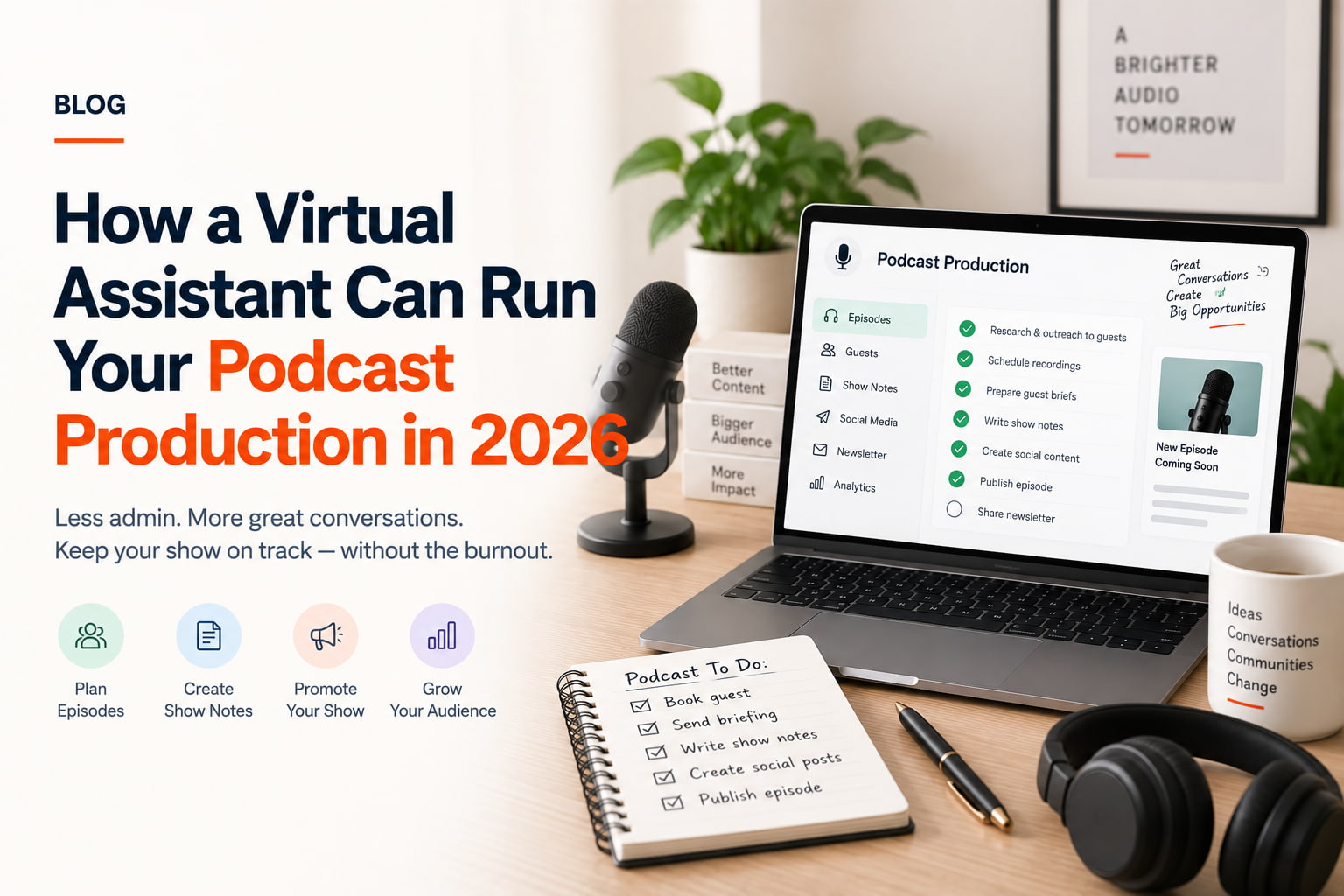
How a Virtual Assistant Can Run Your Podcast Production in 2026
Podcasting is one of the highest-impact content formats for building authority, growing an audience, and attracting clients. But behind every published episode is a mountain of production work that most hosts massively underestimate before they start.
From booking guests and preparing briefs to show notes, audiogram clips, and email promotions — podcast production easily consumes 5–10 hours per episode. A virtual assistant can own most of that workflow, letting you focus exclusively on the conversations that make great content.
Quick Summary
- A podcast VA can handle guest research, briefing, scheduling, show notes, clip creation briefs, publishing, and promotion.
- Most podcast hosts reclaim 4–8 hours per episode by delegating production to a VA.
- AskSunday's dedicated VAs support podcasters across all major platforms and audience sizes.
The Podcast Production Iceberg
The recording itself might take 60 minutes. But the full production workflow looks like this:
| Task | Estimated Time |
|---|---|
| Guest research and outreach | 1–2 hours |
| Pre-interview brief preparation | 30–60 minutes |
| Show notes writing | 45–90 minutes |
| Episode description and SEO | 30 minutes |
| Audiogram and clip brief creation | 30–45 minutes |
| Social media promotion posts | 45–60 minutes |
| Email newsletter segment | 30 minutes |
| Publishing and scheduling | 20–30 minutes |
Total: 5–9 hours per episode — before you record a single word. A VA takes on the majority of these tasks.
The Podcast Production Iceberg
1. Guest Research and Outreach
Your VA identifies relevant guests based on your criteria, researches their background and recent work, drafts personalized outreach emails in your voice, and manages the reply-and-scheduling flow until the recording is booked.
2. Guest Briefing Documents
Before every episode, your VA prepares a comprehensive guest brief: bio, recent highlights, suggested talking points, episode angle, and logistics for the recording session.
3. Recording Scheduling and Coordination
Managing calendar availability, sending calendar invites, confirming recording links (Riverside, Zencastr, Zoom), and sending reminder emails — your VA handles all logistics so guests show up prepared.
4. Show Notes Writing
Using the episode transcript or recording, your VA writes detailed, SEO-optimised show notes including key timestamps, main takeaways, and resource links mentioned in the conversation.
5. Episode Title and Description Optimisation
Your VA writes keyword-rich episode titles and descriptions that improve discoverability on Spotify, Apple Podcasts, and Google Podcasts — applying SEO principles to your audio content.
6. Social Media Promotion Content
Quote cards, audiogram briefs, guest feature posts, and episode announcement content — your VA creates or briefs all social promotion assets and schedules them across your platforms.
7. Email Newsletter Segment
Your VA writes the podcast segment for your email newsletter — a brief episode summary, key insight, and link to listen — so your subscriber list always knows when new content is live.
8. Transcript Coordination
Submitting recordings to your transcription service, reviewing returned transcripts for accuracy, and filing them in your episode library — your VA manages the transcription workflow end to end.
9. Publishing and Platform Management
Uploading audio files to your hosting platform (Buzzsprout, Podbean, Anchor), adding metadata, setting publish dates, and ensuring the episode goes live correctly across all syndicated platforms.
10. Listener Engagement and Review Requests
Responding to podcast listener DMs and emails, monitoring reviews across platforms, and sending review request messages to engaged listeners — your VA keeps your community warm.
VA-Powered Episode Workflow
- Week 1: VA researches and books guest 4 weeks out
- Week 3: VA sends guest brief 1 week before recording
- Recording day: You record. VA sends thank-you and follow-up to guest.
- Post-production: VA writes show notes, title, description, social posts
- Publish day: VA uploads, schedules, and sends newsletter segment
- Ongoing: VA monitors reviews and manages listener engagement
Setting Up Your Podcast VA
- Create a Guest Criteria Doc: your ideal guest profile, topics you cover, audience demographics
- Build an Outreach Template: your standard guest invitation email (your VA customises it per guest)
- Set up a Show Notes Template: your preferred structure, word count, and sections
- Grant access to your hosting platform, social scheduler, and email tool
- Record one Loom walkthrough of your full episode process — your VA references it for everything
Why AskSunday for Podcasters
- Dedicated VA who learns your show's voice, audience, and format
- Experience with major podcast platforms: Buzzsprout, Podbean, Riverside, Zencastr
- Expert backup for copywriting and SEO-optimised show notes
- Flexible plans — scale up during active seasons, pause when taking a break.
Final Thoughts
The podcasters who publish consistently aren't more disciplined than those who don't — they have better systems. A dedicated VA is the production engine that keeps your show on schedule without consuming your week.
Ready to reclaim your recording time? Start your free trial with AskSunday and launch your podcast production system today.
Frequently Asked Questions
1. Can a VA write show notes without listening to every episode?
Yes. Your VA uses the episode transcript or a recording review to write accurate, detailed show notes. Most VAs find transcripts faster and more reliable than full audio review.
2. Can my VA help grow my podcast audience?
Yes. Guest outreach, social media promotion, email newsletter segments, and review requests are all audience growth activities your VA can manage consistently.
3. What if I have an interview-based podcast vs. solo show?
Both formats are well-suited to VA support. Interview shows benefit from guest research and booking. Solo shows benefit from research briefs and show notes. Your VA adapts to your format.